Teaching Philosophy
As with any discipline or art, teaching requires more than repeated performances if one wishes to excel; a teacher must study techniques, observe others, solicit feedback, admit failures, share successes, and plan carefully for the future. I have found that the best way to accomplish these things is to set clear goals and to evaluate my life as a teacher regularly in order to gauge how I am living up to these goals.
Both my graduate career at North Carolina State University and my professional experience have offered me an incredible wealth of opportunity to grow as a teacher. I entered my graduate program, as most do, focused on being a good student and uncertain of what to expect from my new role as an NC State instructor. I was both surprised and gratified at the enormous personal and professional enrichment that I experienced from being on the “other side” of the classroom. Whether helping a non-English major appreciate literature, challenging a talented senior heading to graduate school to excel, providing orientation to a colleague making their first forays into teaching, or attempting to inspire students in my own classroom, I’ve found the guidelines above to be effective and applicable to a wide variety of pedagogical situations.
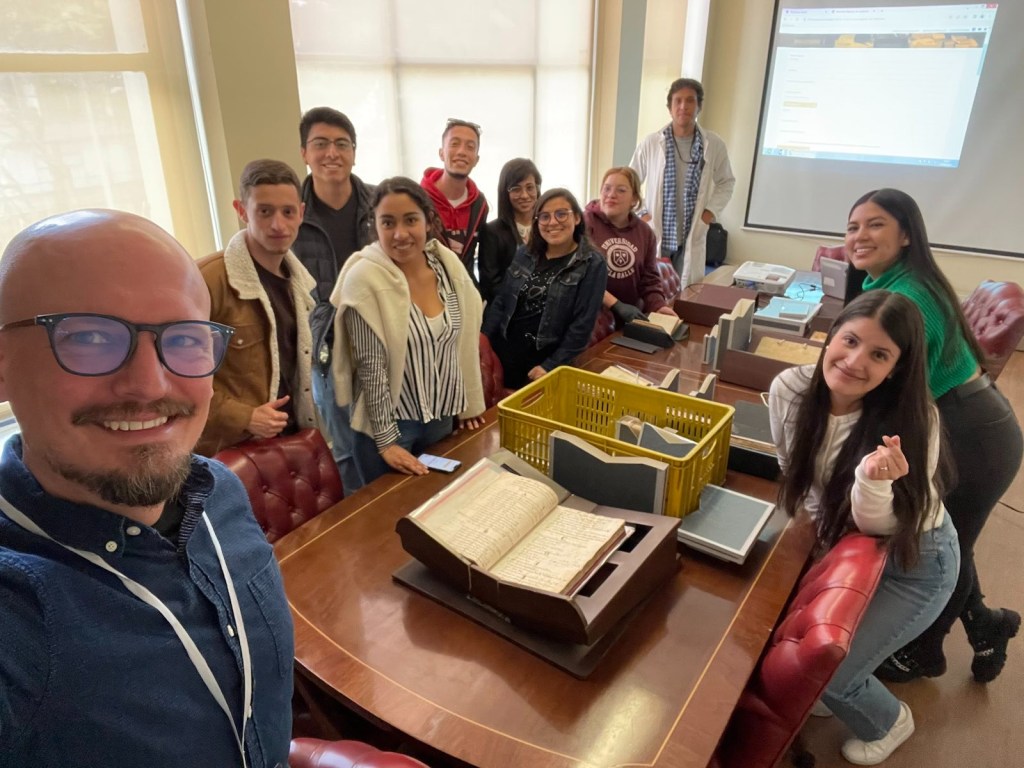
Using an engaged, multimodal pedagogy has had other welcome consequences. Although it is often proposed that the humanities classroom is student-centered, I would insist that the engaged classroom has multiple and shifting centers. Many students are located on peripheries — cultural, economic, emotional — and instructors can help them connect by offering creative forms of participation and response. I strive to create welcoming atmospheres and to open participatory channels for students of all persuasions. Furthermore, I urge them to articulate for themselves why our courses matter, suggesting outcomes but also encouraging them to adapt our studies to their personal interests and professional ambitions. Undergraduates in my early English literature course are confronted with the materiality of manuscripts and tasked with linking theoretical readings about textuality and transmission with applied projects (for example, digital iterations, printed editions, online blogs and podcasts) which embody and extend our critical concerns. I am especially gratified when class projects and conversations have continued beyond our allotted semesters.
As educators and scholars we have a particular responsibility to show our students, peers, and colleagues how technologies and communication practices are often deliberately mediated through specific social actions, discriminatory assumptions, and racially-charged motivations. However, I have found that it is not enough to simply signal support. Efforts toward intersectionality and inclusivity in our classrooms, in our scholarship, and in our professions must not only continue but must also be extraordinarily more apparent. In general, academia has taught me the necessity of diverse representation. In the classroom, I work to increase awareness of canonical limitations in English literature by devoting a significant proportion of my course readings to women’s voices and to expose problems both in the shape of the canon and in surviving vocabulary initially meant to promote a Western Eurocentric worldview. I supplement literature with articles by BIPOC scholars, including those that address the current appropriation of medieval imagery and ideology by white nationalists.
My teaching style follows Alyson Campbell’s idea of queering knowledge production and necessary “messiness” in learning. In this respect, I push back on pedagogical methodologies that prescribe a limited number of learning trajectories. Consequently, while I am skeptical about quantitative metrics and prescribed outcomes for higher education, I am not shy about the usefulness of a humanities education and its vital public and professional functions. For me, it starts by demonstrating to students the surprising relations of our courses to public and technological environments. I am grateful to see it continue when students carry forward their projects and perspectives to other walks of life.
Courses
Literature Courses
- Medieval Literature
- Chaucer
- British Literature I
- British Literature II
- World Literature I (Honors)
- Women Writing Women: Five American Portraits
- American Literature I
- Introduction to Literature
Digital Humanities/Data Science Courses
- Digital Humanities, Data, and Ethical Representation
- Theory and Methods in the Digital Humanities
- Text and Technology
- Digital Rhetoric and Digital Humanities (Topics in Media and Rhetoric)
- Data Visualization: Tools and Techniques
- Data Wrangling and Web Scraping
- Data Science for Policy
- Text Analysis with Natural Language Processing
- Data and Ethics
- Data Physicalization
Reading/Writing Courses
- Writing and Critical Literacy
- Developmental Reading
- Expository Writing
- Writing and Research Across the Discipline
Communication Courses
- Public Speaking and Oral Communication
- Communication Media in a Changing World
- Environmental Ethics
Highlighted Student DH Projects
Threads of Masculinity (Caleb Jones, Aldon Pilz, and Tia Rizvi)
INFOMIGR (Nikole Trycia Arenas Prieto and Daniel Alonso Del Carpio Zavala)
Opioid Overdose (Athena He, Corinna Herman, Brooks Kastor, and Avril Larios)
Video Lectures
 James Buffington Harr III, Ph.D.